


Making sense of KSA’s capital market
The Key Takeaways:
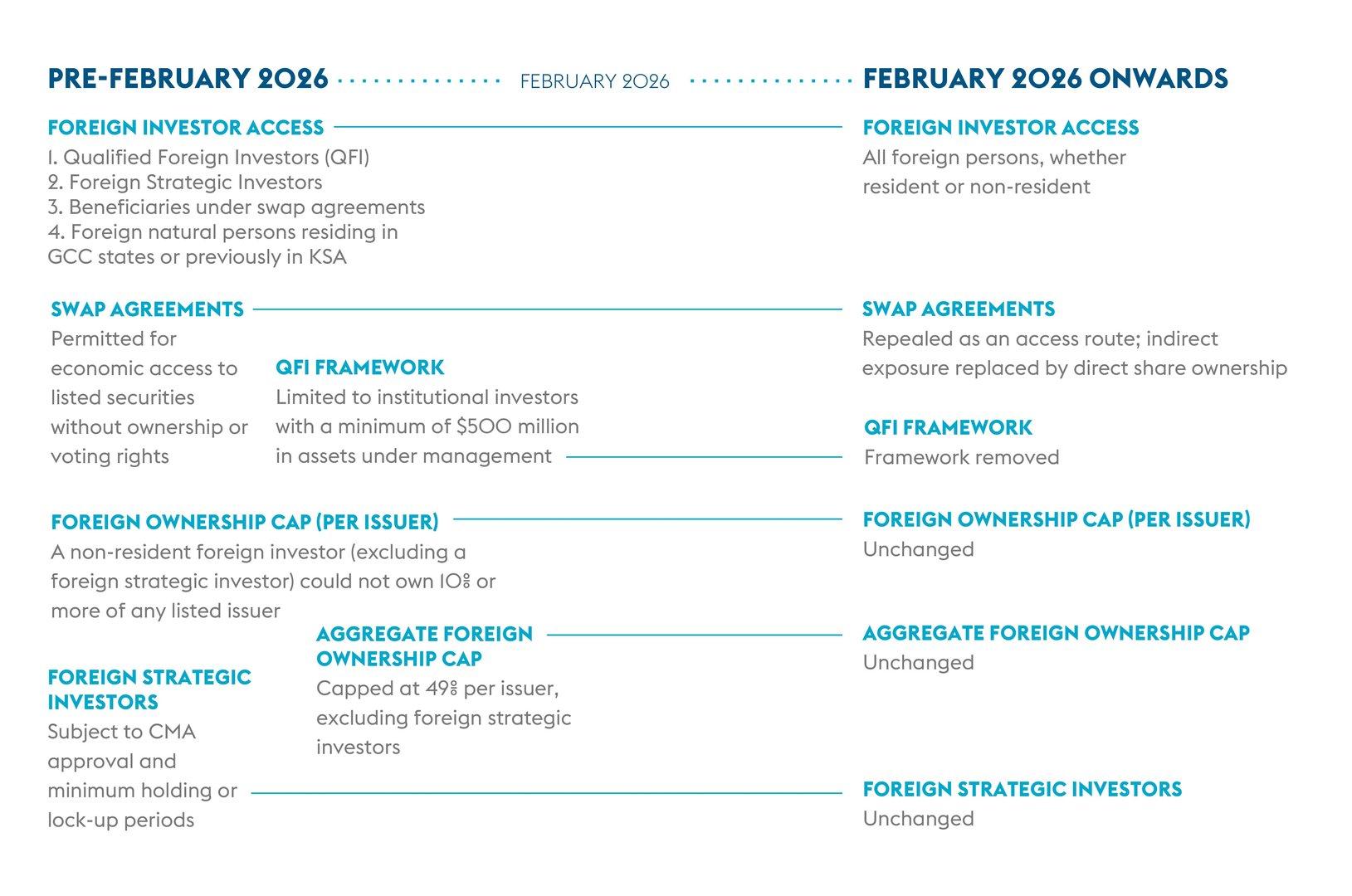
1. Access has been fully liberalized, not ownership. All foreign investors, individual and institutional, resident and non-resident, can now invest directly in Saudi’s stock exchange. At the same time, the 10% per-investor cap and the 49% aggregate foreign ownership limit remain in place, with foreign strategic investors preserved as the sole route to controlling stakes.
2. The qualified foreign investor framework and swap-based access have been retired. Institutional qualification thresholds, including the SAR 1.875 billion assets under management requirement, have been abolished, and swap agreements have been removed as a prerequisite access mechanism.
3. The new regulation comes at a time when the market is calling for it. Following a sluggish 2025 for capital markets, marked by underperformance, the CMA’s move signals confidence in developing the market’s infrastructure by diversifying liquidity sources and improving the secondary market's functioning.
4. Capital base expansion is critical for the 2026 IPO pipeline. With dozens of IPO applications already submitted and a broader pipeline forming, opening the market beyond institutional investors is intended to widen the pool of deployable capital, support valuations, and absorb upcoming issuance.
5. Further inflows hinge on future ownership reform. While the opening is expected to gradually lift participation, market participants continue to view any relaxation of the 49% foreign ownership cap as the key catalyst for the next phase of sustained inflows.
On February 1, 2026, the Capital Market Authority (CMA) officially allowed all categories of foreign investors to invest directly in Tadawul’s main market in a historic liberalization move to broaden the investor base and support liquidity in the Middle East’s largest equity market. Under the new rules, a wider range of foreign investors, including individuals and institutions, whether resident or not, can open investment accounts and trade listed securities directly on the exchange through Saudi-licensed brokers.[1]
The new regulations remove longstanding barriers to entry. Previously, non-resident foreign investors could access Tadawul’s main market through specific regulatory channels—either as Qualified Foreign Investors (QFIs) limited to institutional investors with at least SAR 1.875 billion ($500 million) in assets under management (AUM), or indirectly through swap arrangements that mirrored returns of Saudi equity without conferring legal ownership.[2] These qualifications and route-based requirements have now been eliminated, allowing foreign investors to access the market directly without meeting predefined eligibility thresholds.
While access barriers are lifted, existing foreign ownership limits are still in place. Individual non-resident investors remain barred from owning 10% or more of any listed issuer, while total foreign ownership—across all investor categories, excluding foreign strategic investors—is capped at 49%. Furthermore, foreign strategic investors may exceed these limits, subject to regulatory approval and minimum holding or lock-up periods.
Table 1: Main changes in the KSA capital market
Source: Argaam and Saudi Capital Market Authority
How foreign access to Tadawul evolved
The CMA has adopted a philosophy of gradual foreign inclusion in the Saudi capital market since the authority’s inception in 2003, allowing foreign investors to economically benefit from Saudi stocks through swap arrangements starting in 2008, and eventually permitting direct ownership for qualified investors through the QFI framework in 2015.[3] Back then, foreign investors needed to have $5 billion in AUM to qualify for market participation. Each QFI could own no more than 5% of a single listed company’s shares, and all foreign investors combined could own at most 20% of any company.
Time travel: The sequence of foreign investor access to the KSA stock exchange
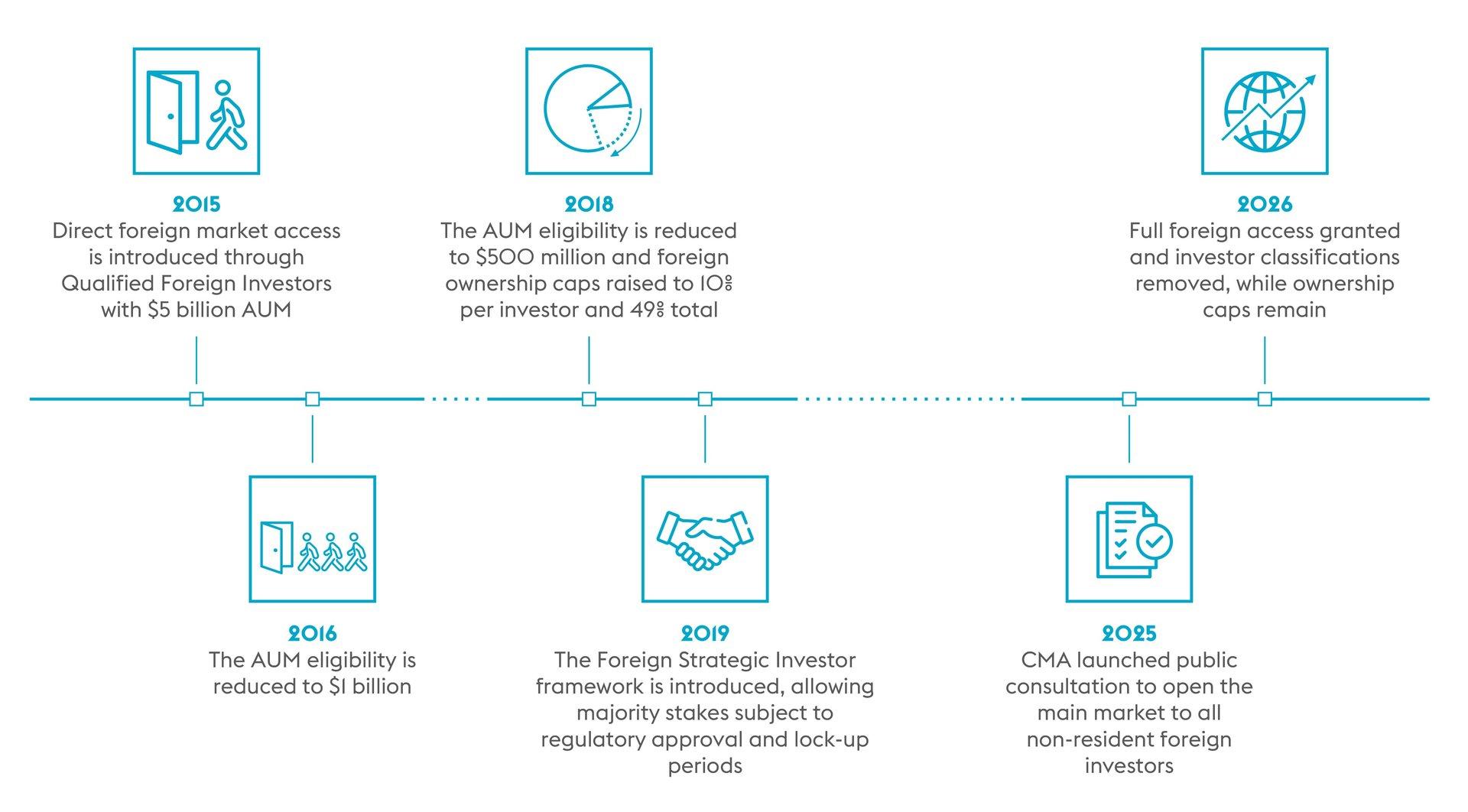
1. In 2015, direct foreign market access is introduced through the Qualified Foreign Investor framework with a $5 billion AUM requirement.[4]
2. In 2016, the minimum AUM requirement was reduced to $1 billion, and the scope of eligible institutions was expanded to include sovereign wealth funds, pension funds, university endowments, and other quasi-governmental institutions.[5]
3. In 2018, the AUM threshold was further lowered to $500 million, opening the market to a broader pool of international institutional investors. In the same year, the individual ownership cap per QFI was increased from 5% to 10%, and the aggregate foreign ownership cap per company was raised from 20% to 49%, aligning Saudi policy with other GCC markets.[6]
4. In 2019, the CMA introduced the Foreign Strategic Investor (FSI) framework, allowing strategic investors to exceed the 49% cap and acquire majority stakes in listed companies, subject to a two-year lock-up and regulatory approval.[7]
5. In 2025, the CMA launched a public consultation on proposals to open the main market to all categories of non-resident foreign investors, outlining plans to eliminate the QFI framework and abolish swaps.[8]
6. By February 2026, all foreign investors, whether institutional or individual, will be permitted direct market access, effectively retiring the QFI designations. In terms of ownership, however, the 10% individual cap and 49% aggregate limit remain in effect outside the FSI route.[9]
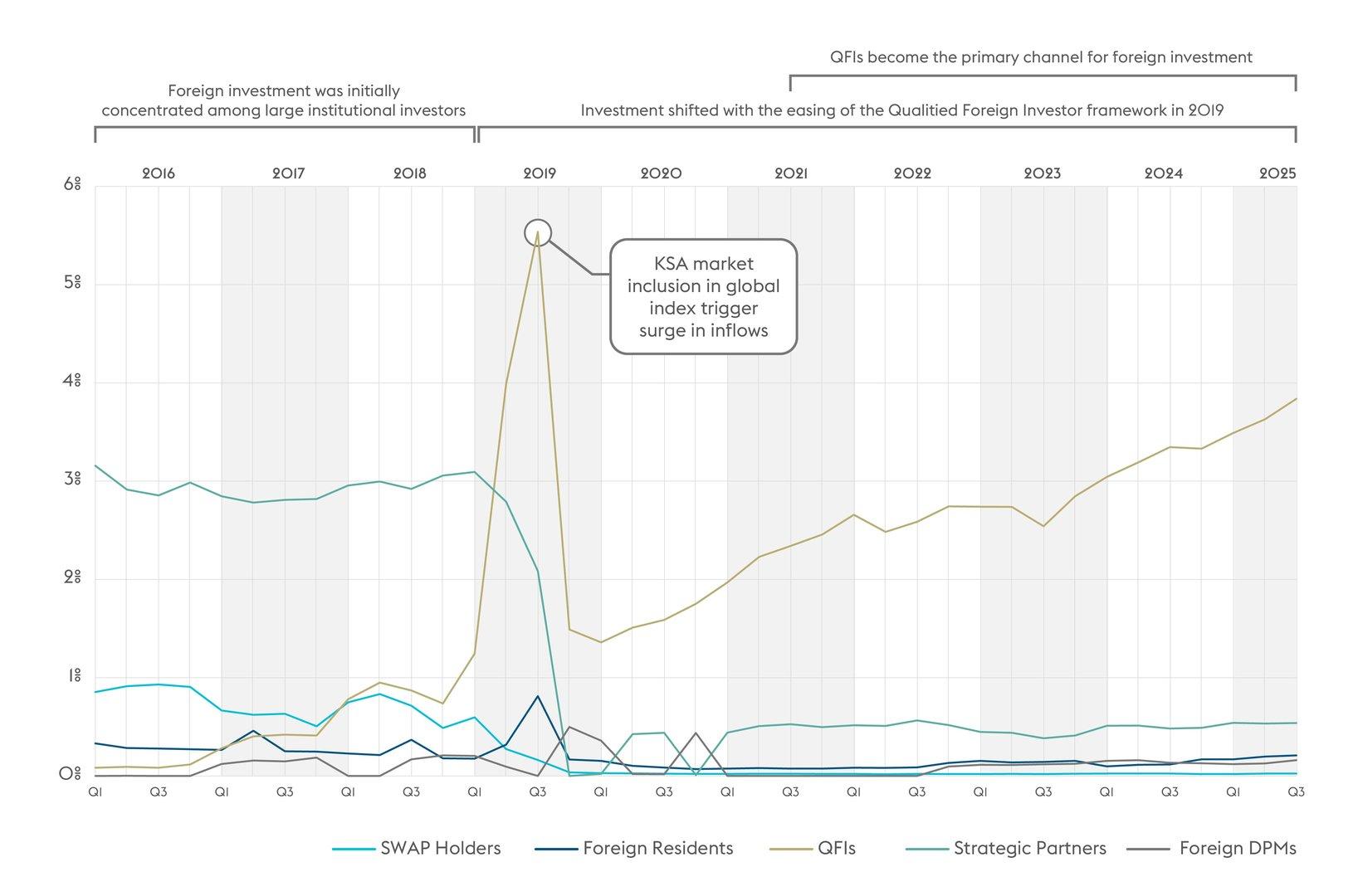
In incremental openings, the CMA reeled in foreign investors to Saudi Arabia’s main market through the QFI framework while maintaining ownership limits. The sharp and steady rise in QFI holdings as of 2018-2019 coincided with successive relaxations in eligibility and ownership thresholds in Saudi Arabia’s stock exchange (Figure 1) and its inclusion in major global indices like the MSCI Emerging Markets. By the end of 2025, the stock exchange had roughly 4,500 registered QFIs, with participation spanning major global asset managers such as BlackRock, Franklin Templeton, and JPMorgan Asset Management.[10]
Figure 1: Tadawul foreign ownership by category
Source: Capital Market Authority.
What the policy serves
The CMA’s move to broaden foreign investor access to Tadawul serves a dual macro-financial objective. In the near term, the reform reinforces capital market liquidity following the past year’s index underperformance, contracting trading volumes, and weaker liquidity conditions. In the medium-to-long term, it is a step to expand the deployable capital base needed to absorb a growing pipeline of upcoming public listings.
1. Supporting capital market resilience
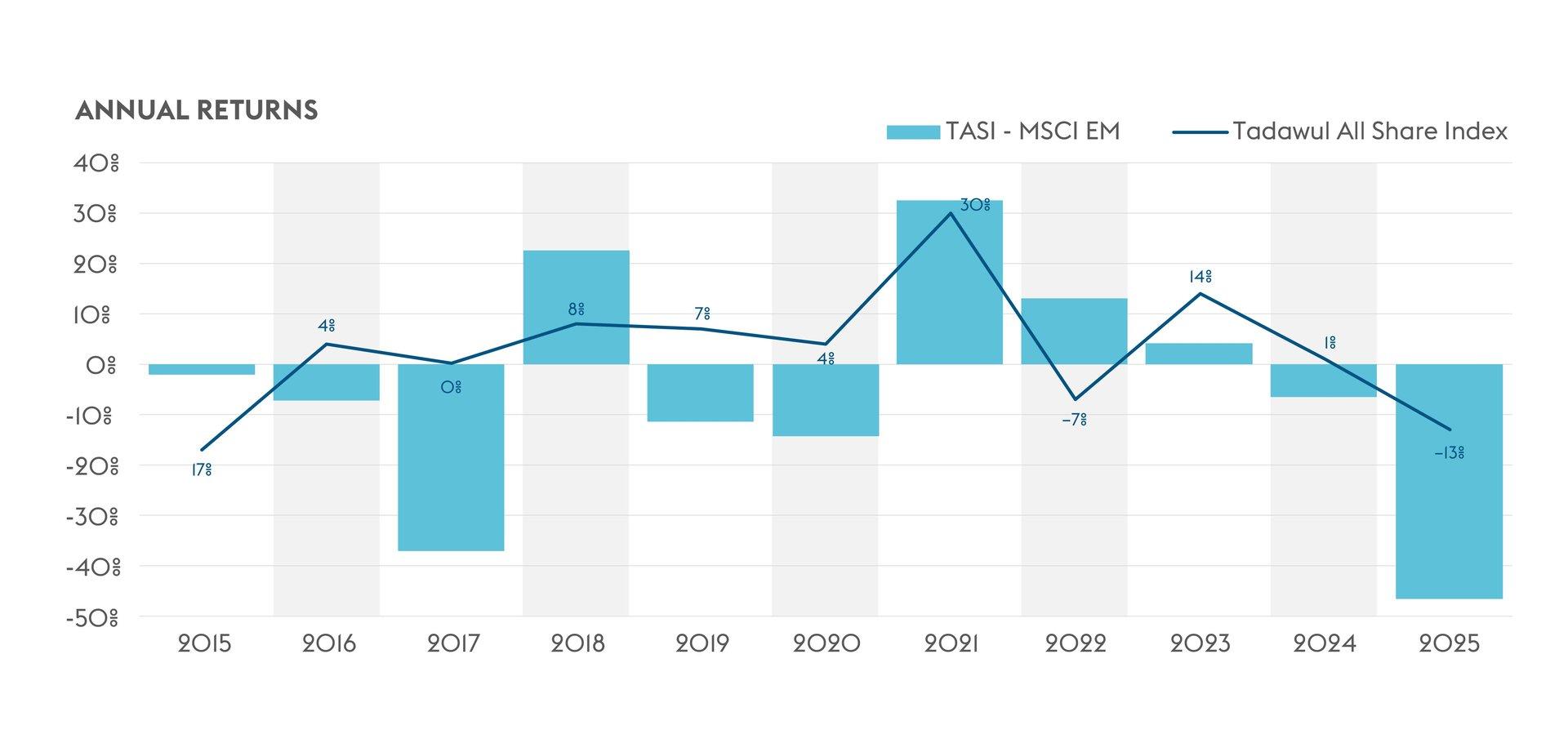
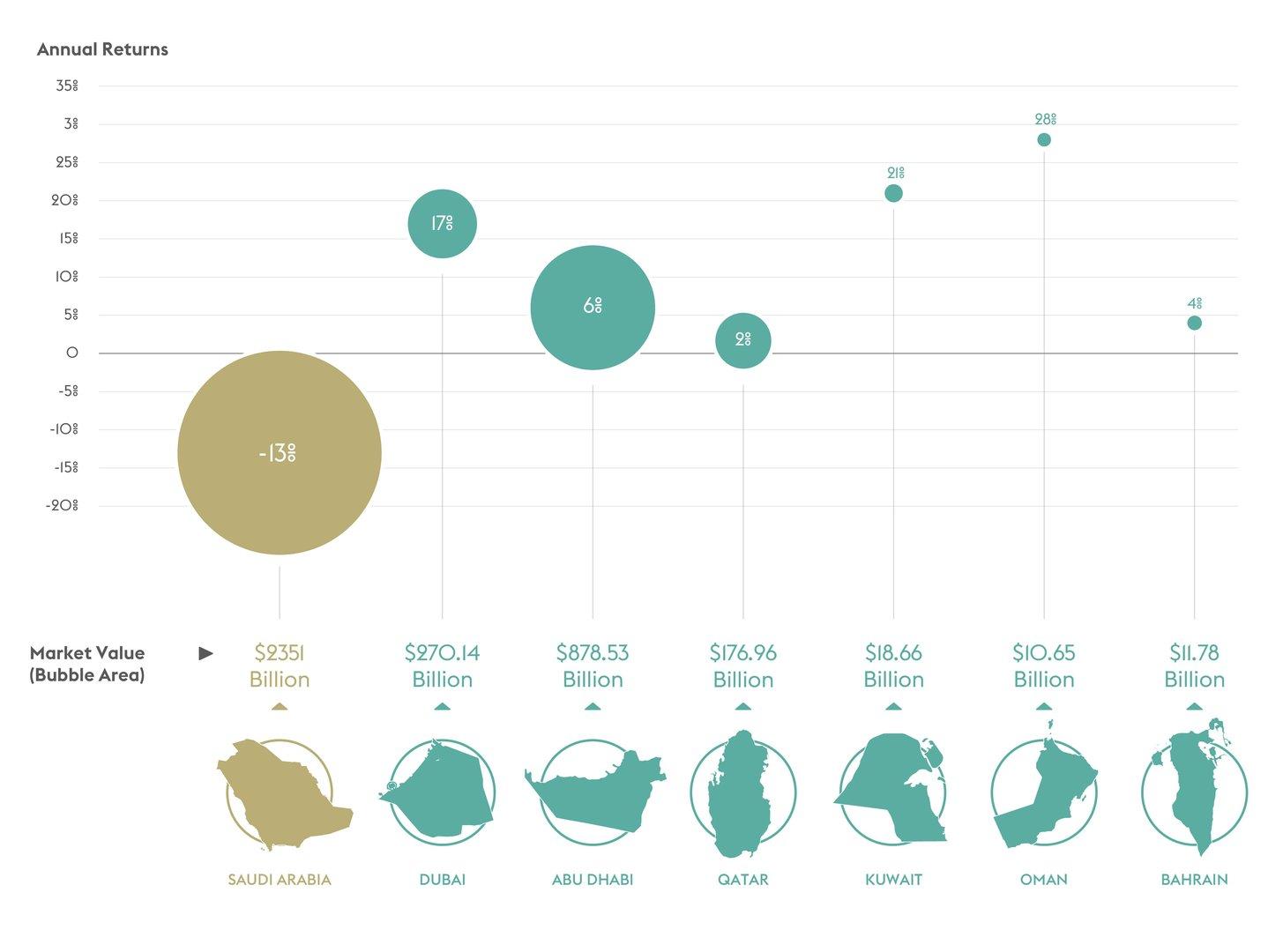
The Saudi Tadawul All-Share Index (TASI) closed 2025 down about 13%, its steepest annual decline since 2015 when the index fell by 17% (Figure 2). The index trailed its emerging market peers and the MSCI Emerging Markets Intex,[11] standing out as the only market in the GCC to end 2025 in negative territory. While the underperformance was driven by a confluence of factors, including heightened geopolitical tensions, falling oil prices, soft corporate earnings, and attenuated post-IPO returns,[12] TASI’s concentration in energy and materials had the largest impact. Specifically, the energy sector, led by Saudi Aramco, fell approximately 15%, while the materials sector declined around 11%, with SABIC affected by softer global demand and commodity price pressures.
Although foreign investors were net buyers over the year, increasing their holdings in the main market from SAR 498 billion at the end of 2024 to SAR 519 billion by Q3 2025, total trading volumes contracted sharply (-30%).[13] Motivated by this, regulators annulled the QFI framework and expanded access for foreign investors to the stock exchange, with the stated aim of supporting investment inflows.
Figure 2: Annual return of TASI relative to MSCI emerging markets
Source: MSCI Saudi Arabia Index, and Argaam
2. Expanding the capital base for the growing IPO pipeline
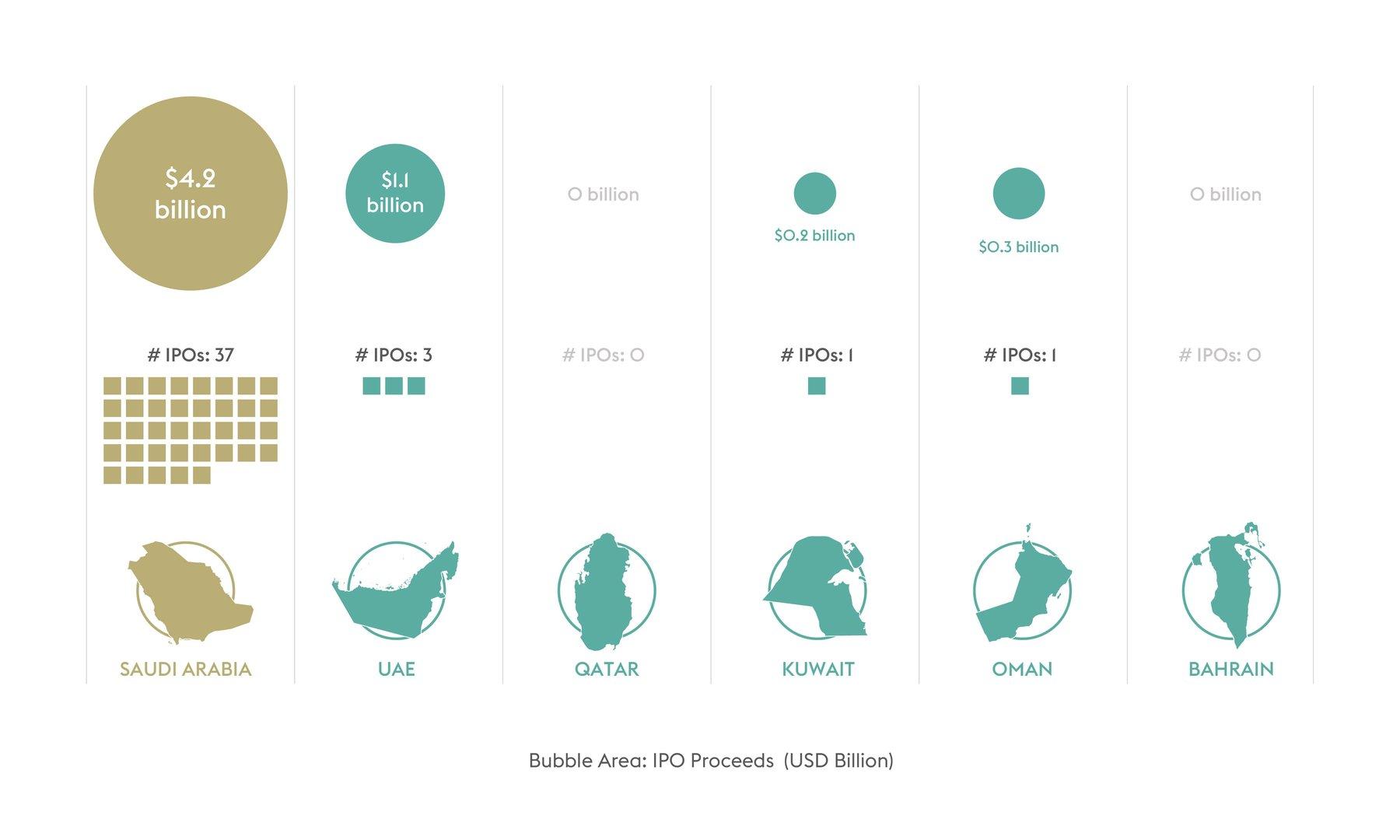
Despite the main market’s underperformance in 2025, Saudi Arabia remained the dominant IPO venue in the GCC, anchoring both current issuance and the region’s forward listing pipeline. The Kingdom accounted for around 88% of all GCC IPOs, with 37 out of 42 listings debuting on either the main market or Nomu (Saudi’s parallel equity market for SMEs). This activity translated into approximately $4.1 billion in IPO proceeds across Saudi Arabia’s two markets (Figure 3).
Projecting for 2026, the pipeline looks promising. Around 40 companies have already submitted IPO applications, with the broader pipeline reaching up to 100 firms once companies currently engaging financial advisers are included.[14]
Figure 3: IPO activity across the GCC in 2025
Source: Kamco Invest
Figure 4: Market cap and equity performance of GCC stock exchanges in 2025
Source: Argaam and Tadawul.
The next catalyst for capital inflows
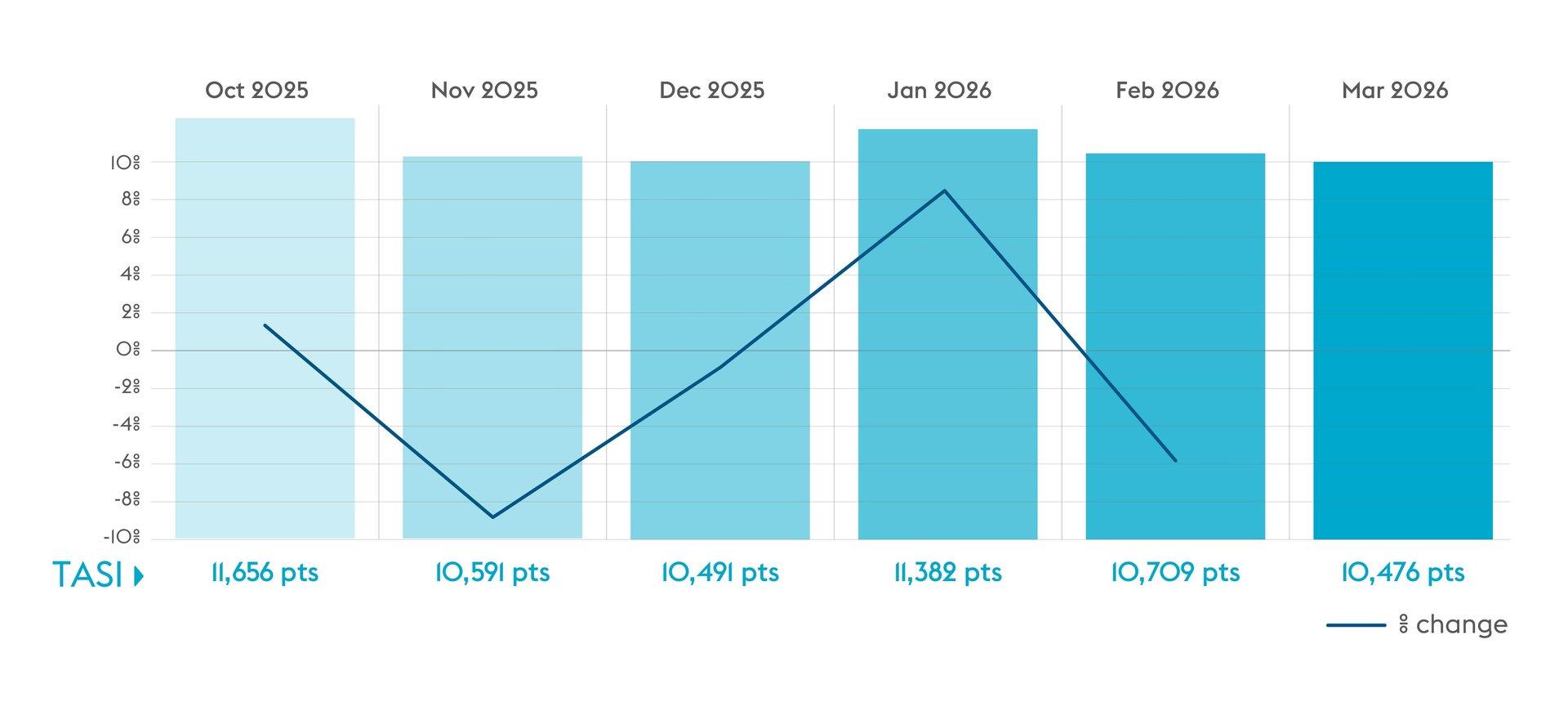
The opening of Tadawul to foreign investors, though a historical milestone in the Kingdom’s capital-market liberalization, has its potential impact a function of how ownership rules evolve from here. Market behavior surrounding the reform period shows a pattern of speculative repricing ahead of the anticipated formal implementation, particularly between October 2025 and January 2026. And in the short-to-medium term, as the immediate effects of access liberalization are absorbed, attention will shift to the regulatory treatment of foreign ownership limits,[15] widely regarded as the principal structural determinant of sustained capital inflows and global market integration.
Speculation has had imprints on market pricing around the reform period. The TASI fell 1.9% on the first trading day following the full opening of the market to foreign investors as heightened geopolitical risk and a slump on metals prices offset earlier optimism.[16] The pullback followed a strong January rally, when the index rose 8.5% as markets priced in the removal of the QFI regime and stronger liquidity expectations.
Figure 5: TASI performance between October 2025 and February 2026
Source: Tadawul
In terms of foreseen impact, the market opening is expected to support a gradual strengthening of foreign participation and liquidity, rather than create a rapid surge in capital inflows. Effects are likely to remain concentrated in large, highly liquid securities in the near term, with broader market impacts emerging progressively as new investors establish positions over time.[17]
And while the market standing today represents the culmination of sequenced liberalization interventions that have unfolded over more than a decade, the 49% foreign ownership cap sits as catalyst for the development of broad-based investor confidence and the next wave of inflows.[18] As the CMA reviews the restriction this year,[19] estimates reveal that increasing the ceiling to 60-100% could attract between $3.4 and $10.2 billion in passive inflows.[20]
----
[1] Capital Market Authority. “Rules for Foreign Investment in Securities, as amended January 2026.”
[2] Capital Market Authority. “Draft Regulatory Framework to Allow Non-Resident Foreign Investors to Invest Directly in Shares Listed on the Main Market.”
[3] Capital Market Authority. Strategic Plan 2021–2023
[4] Al Tamimi & Co. July 2015. “Saudi Stock Market Opens for Foreign Investment.”
[5] Capital Market Authority. “CMA Further Expands Foreign Investors Access to Saudi Capital Market.”
[6] Bloomberg. January 2018. “Saudi Arabia to Allow Foreigners to Own 49% in Listed Securities.”
[7] Bloomberg. June 2019. “Saudi Regulator Scraps Ownership Limit for Strategic Investors.”
[8] Capital Market Authority. October 2025. “The Capital Market Authority Calls for Public Consultation on Opening the Main Market to All Categories of Non-Resident Foreign Investors.”
[9] Greenberg Taurig. January 2026. “Saudi Arabia Abolishes QFI Status and Opens the Market to All Foreign Investors.”
[10] Semafor. October 2025. “Saudi Considers Removing Foreign Investor Restrictions on Stocks.”
[11] MSCI is an index that captures stocks from 24 emerging markets.
[12] EnterpriseAM KSA. January 2026, “TASI’s Correction Year.”
[13] Calculation based on data from Tadawul and Argaam.
[14] Bloomberg. December 2025. “Saudis Tout ‘Vibrant’ IPO Pipeline Ahead of Market Reforms.”
[15] Bloomberg. February 2026. “Saudi Regulator Says Foreign Stock Ownership Limits Under Review.”
[16] Asharq Business. February 2026. “أداء سوق الأسهم السعودية اليوم 1 فبراير 2026.”
[17] Argaam. January 2026. “Saudi Market Opening to Foreign Investors.”
[18] Bloomberg. September 2025. “Saudis to Free Stocks from Local Grip in Major Equity Push.”
[19] Bloomberg. February 2026. “Saudi Regulator Says Foreign Stock Ownership Limits Under Review.”
[20] Bloomberg. January 2026. “Saudi Arabia Opens Capital Market to All Foreign Investors.”