


The Diversification Paradox: What AI diffusion means for Saudi Arabia’s labor market
The Key Takeaways
AI’s exposure penetrates cognitive services deeper than physical ones.
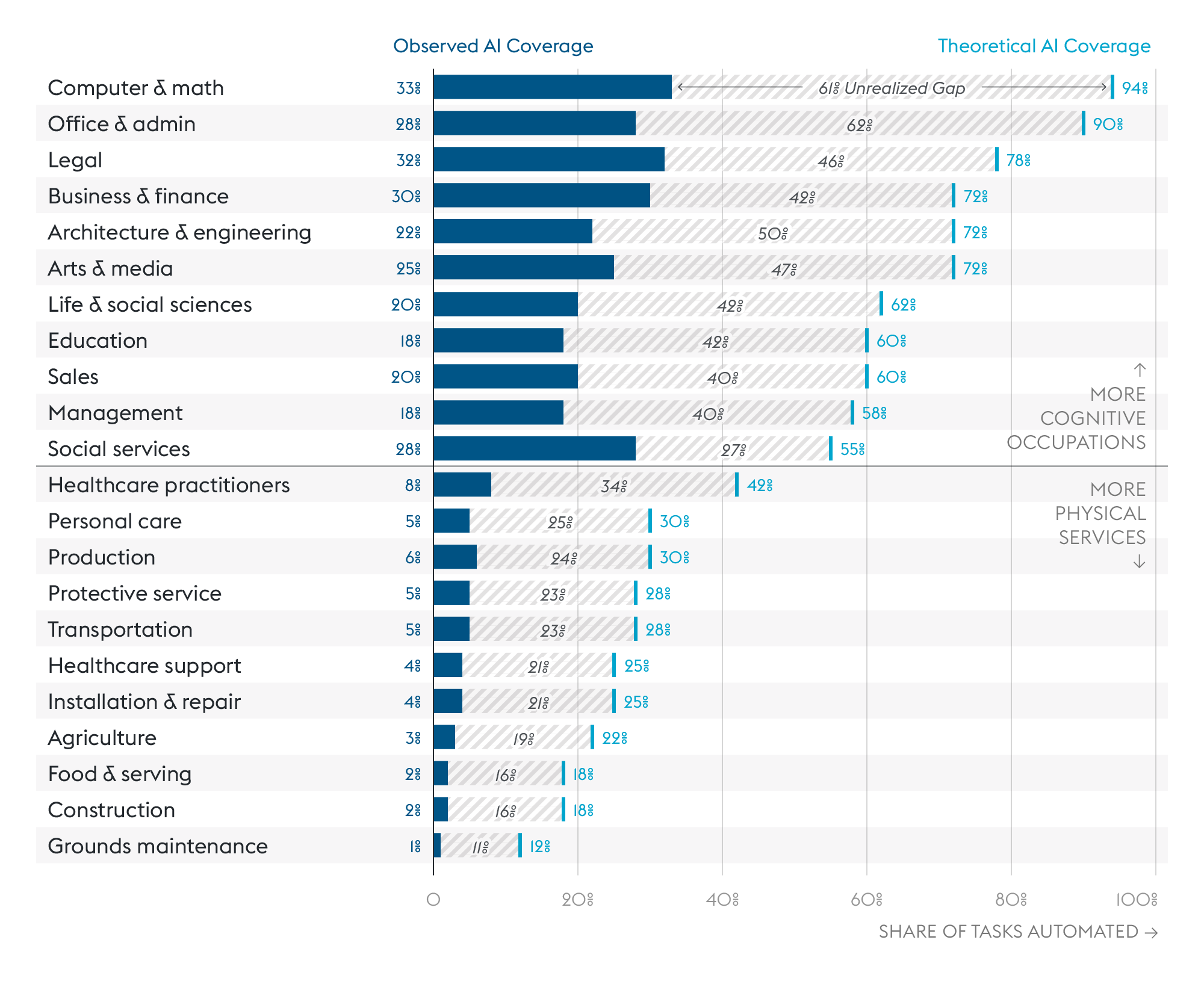
Recent research corroborates this further, with nearly full theoretical automation exposure for computer and mathematical occupations, while those in maintenance, food services, and construction register less than 20% theoretical exposure.
A large deployment gap persists.
AI’s theoretical coverage exceeds 80% in occupations such as computing, finance, and management, yet observed deployment covers only a fraction of that scope. The gap provides a finite, closing window for labor market preparation and adaptation.
Saudi nationals are disproportionately concentrated in exposed occupations.
Nearly one in two Saudi employees work in occupations with high theoretical AI exposure, notably in management, administration, and sales jobs. Expatriate-dominated sectors such as construction and food services register below 20% exposure.
Youth face a compressed transition window.
Around one-fifth of Saudi nationals are aged 15–24, and preliminary evidence suggests a slowdown in entry-level hiring in AI-exposed occupations since 2022. The current youth bulge will encounter peak AI exposure upon labor market entry, while subsequent cohorts will inherit an already-reshaped occupational structure.
Manufacturing offers a strategic buffer.
Saudi nationals account for roughly 7% of manufacturing employment, compared to about 13% in high-income economies. The sector’s documented untapped potential according to our previous research and lower AI exposure position it as a viable absorption channel for labor market entrants.
Directions moving forward.
The convergence of diversification priorities and rising AI exposure creates a paradox that calls for monitoring the adoption gap’s closure rate across priority sectors, tracking entry-level hiring erosion, and mapping AI-complementary skill sets to inform curricula reform.
Context
On March 10, 2026, the Saudi Cabinet formalized AI as a whole-of-government priority under Vision 2030, consolidating an accelerating policy trajectory.[1] Recent initiatives, like the launch of HUMAIN, a PIF-owned company building full-stack AI infrastructure and the commitment to invest $100 billion in compute power, are only some symptoms of the scale of the Kingdom’s ambition.[2] Yet less examined, however, is the labor market readiness to absorb and adapt to these investments—i.e. what this transformation implies for the current and incoming workforce.
Since the trigger of generative AI, much of the public discourse has assumed a direct pass-through between what the technology can do and what it will do, and by extension, between AI’s demonstrated capability and its realized labor market effects. In reality, the relationship is more complex and largely influenced by factors like technology access, regulatory control, and organizational adoption.[3] The Gartner Hype Cycle is a prominent abstraction of this bias for optimism, as historical forecasts of technology-driven job displacement have previously overstated the speed and uniformity of labor market disruption, in part because they underweight the institutional frictions that govern diffusion or overestimate the maturity of technologies.[4]
Recent empirical work on this phenomenon provides a more precise way of measuring the gap between expected and actual automation.[5] The results echo that AI’s real exposure is significantly smaller than its theoretical potential. In computing occupations, for example, large language models appear capable of accelerating the vast majority of tasks, yet observed deployment currently covers only a fraction of that scope.
The implication for the labor market is that AI’s impact is not being observed as a shock. It is instead propagating through incremental organizational adoption, varying in pace and depth across sectors, firm sizes, and country contexts. For policymakers and businesses in economies pushing toward knowledge-intensive industries, like Saudi Arabia is, attention is needed to find the pace at which the gap between capability and deployment is closing, and whether education outcomes and labor market institutions are calibrated to supply and absorb the adjustment.
Aim and scope
This report advances the understanding of AI’s impact on the GCC’s labor markets, with a focus on Saudi Arabia. It maps AI exposure against the Kingdom’s and GCC’s employment structures, identifies the occupational segments where nationals are most concentrated relative to automation risk, and examines the Saudi demographic and sectoral dimensions that shape the adjustment path. The report concludes with three directions for future research that can inform education and labor market policy.
Framework and methodology
This report applies the recent empirical findings of AI’s deployment on the GCC and KSA labor market contexts. Our approach aims to translate the capability gradient of artificial intelligence from an occupation level to an economic activity level in order to estimate the upper-bound segments of the labor force most exposed to automation.
Data
1. AI exposure: Collected from Anthropic research, theoretical AI coverage is defined as the share of tasks within an occupation where AI has capability, while observed AI coverage is defined as the share of tasks where AI use is documented in practice.[6]
2. Country-level employment data: Total workforce and national employment structures are collected from the General Authority for Statistics for Saudi Arabia and the labor market observatory from the UAE.[7]
3. Benchmarks: Employment ratios by economic activity for the GCC, high-income countries, and world average are compiled from the GCC-stat center and the International Labor organizations.[8]
4. CEO sentiment: Expectations regarding AI’s workforce impact by sector are drawn from a proprietary survey of 300 CEOs in Saudi Arabia.[9]
Framework to match occupations with economic activity
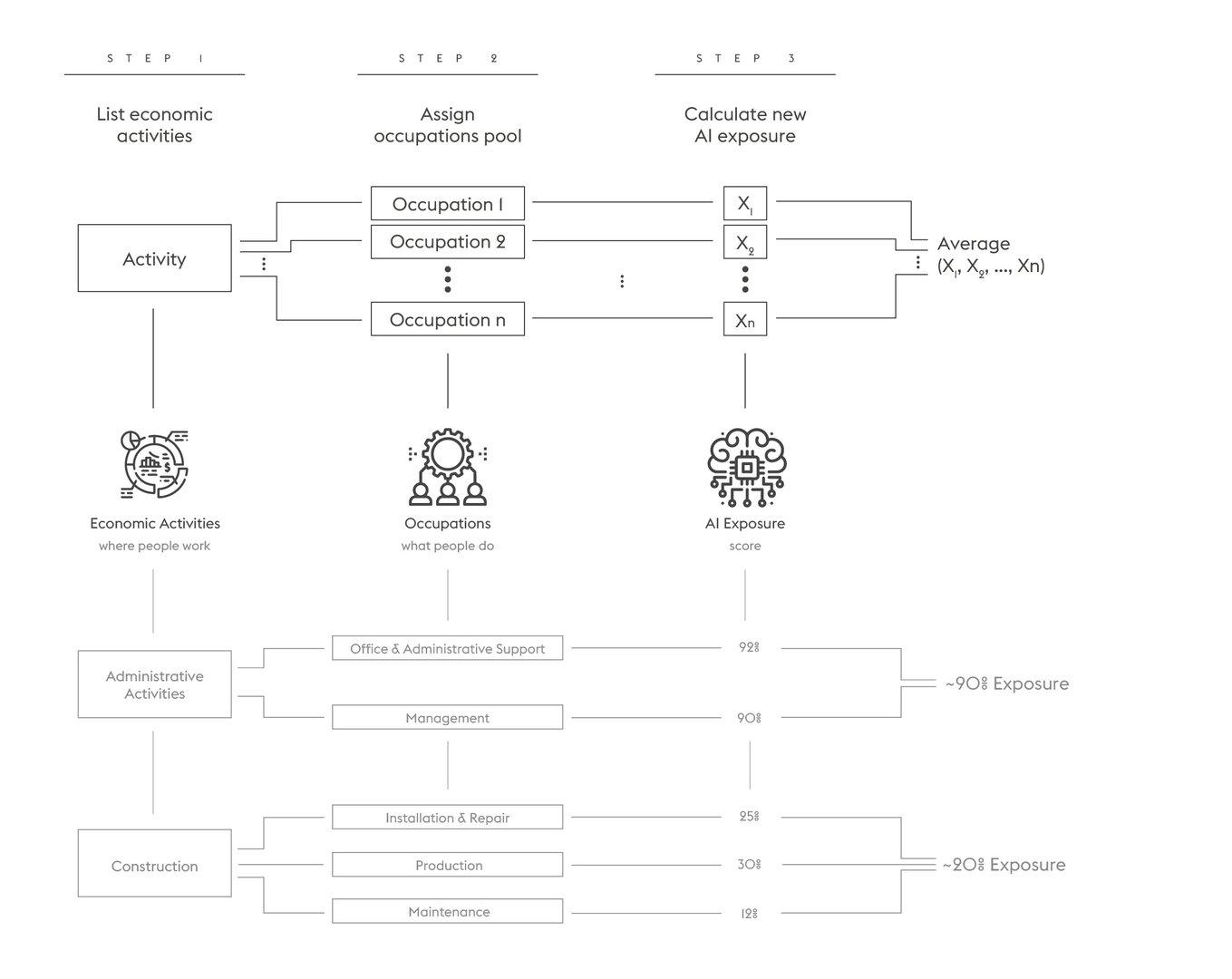
The central challenge is that AI exposure scores are organized by occupation, following the International Standard Classification of Occupations (ISCO), while national employment statistics are organized by economic activity, following the United Nations’ Industrial Classification (ISIC). The two taxonomies are complementary in that one measures what people do (ISCO) versus where they work (ISIC).
To reconcile this, we apply an analytical framework that maps each economic activity to one or more occupational categories that best captures the task composition(s) of that industry. The AI exposure score for each economic activity is then a function of its occupational proxy. Where an economic activity draws on multiple occupations, we derive simple or weighted averages of the occupation(s)’s score.[10]
Figure 1: Analytical framework
Source: Strategic Gears based on Anthropic, ILO, and UNSD.
Caveats
1.Proxy limitation. The framework assigns a standard AI exposure to all workers within an economic activity, irrespective of their occupation within the activity. Constructing a disaggregated index would require detailed occupation-by-sector data that is not uniformly available.
2.Missing values. Employment shares by economic activity for the GCC, high-income countries, and the world are compiled from reference years between 2022 and 2024 and via econometric imputations to control for missing values.[11]
AI exposure in KSA
Two factors characterize the Kingdom’s exposure profile. First, the current employment structure, which has most Saudis in public administration, sales, and education occupations, and most non-Saudis in service and construction roles. And second, the demographic structure, which highlights a sizable youth population that will meet the narrowing gap between AI capability and deployment within five years, compressing the policy window for adjustments.
Determinants of automation
AI’s exposure gradient runs deeper in cognitive occupations compared to physical services. Recent data from Anthropic corroborates this further, with the automation exposure for computer and mathematical occupations potentially reaching 96% and 94% respectively (Figure 2), while workers in maintenance, food services, and construction register less than 20% theoretical exposure.
Figure 2: The capability deployment gap of artificial intelligence, by job occupation
Source: Retrieved from Anthropic.
Asymmetry between nationals and foreigners
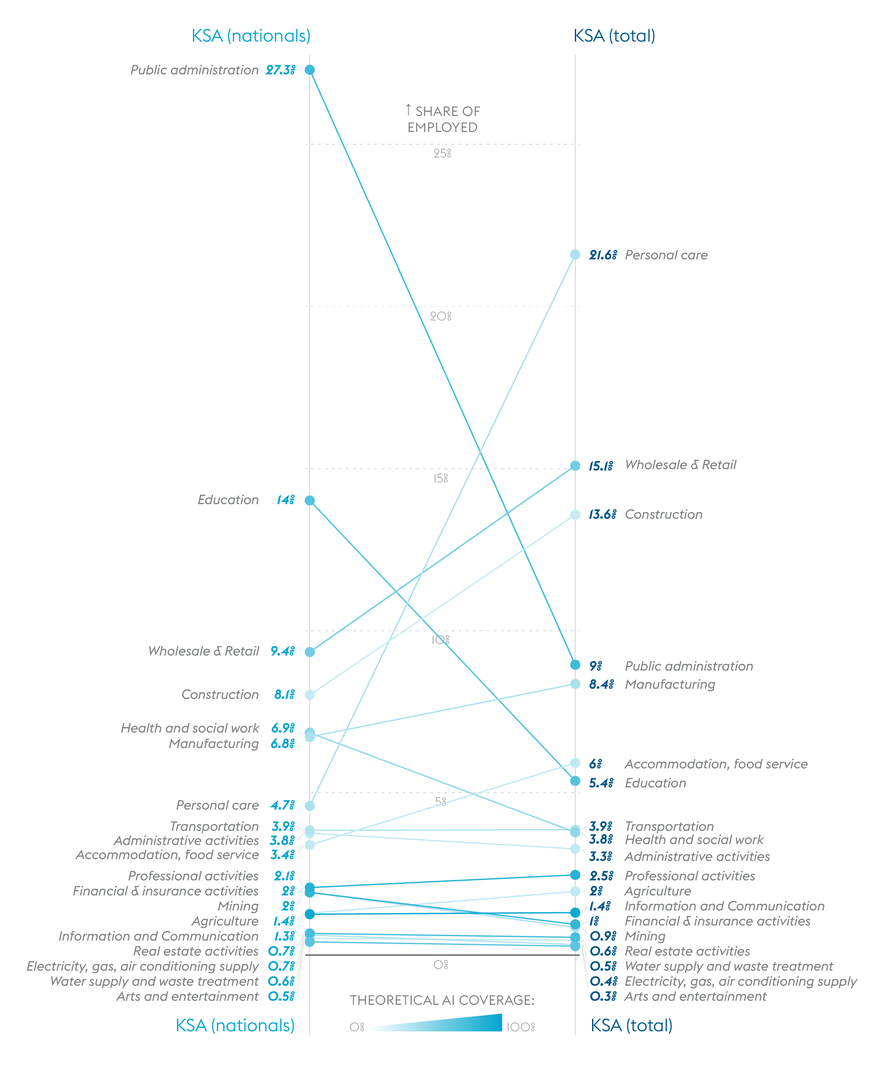
For Saudi Arabia, crossing this with the most recent employment statistics shows a pronounced asymmetry between the exposure of nationals vis-à-vis foreign workers (Figure 3).[12] Nearly one in two Saudi employees work in occupations potentially highly exposed to automation (>60%), including in retail, education, and managerial and administrative roles. At the other end of the distribution, the sectors that rank low on AI exposure—construction, hospitality services, and personal care—are mostly expatriate-staffed and sit outside the diversification and nationalization agendas.
Figure 3: Share of total employed in KSA by AI-exposed occupations
Source: Analysis based on data from Anthropic and GASTAT.
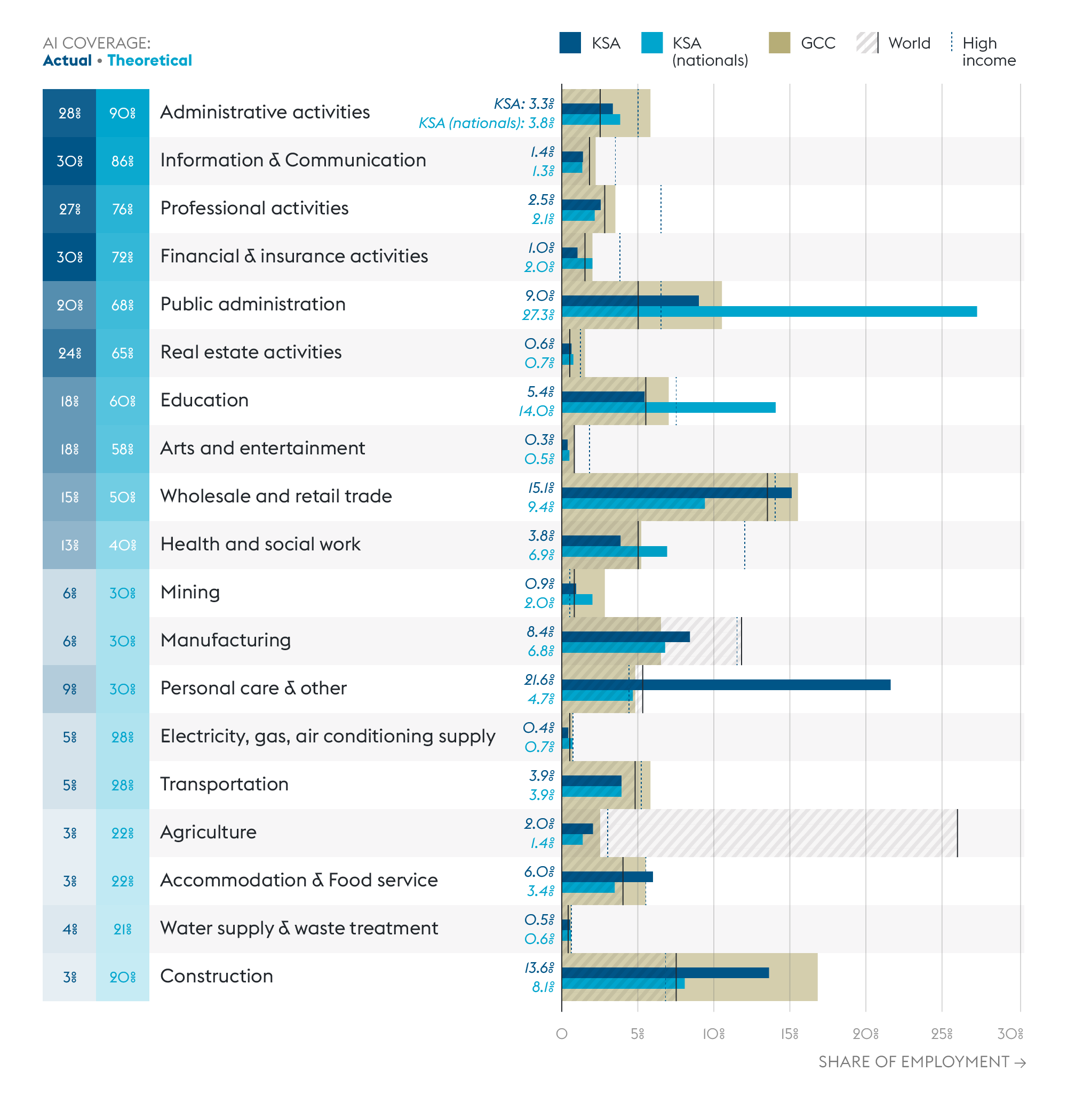
This trend is consistent with the GCC’s, with limited discernable differences (Figure 4). Highly AI-exposed occupations are where most GCC nationals are absorbed with the exception of construction (11%)—although not automatable, most of the sector is expatriate-staffed. Manufacturing emerges as a sector where more Saudis are particularly underemployed compared to high-income economies, accounting for 7% vs around 13% respectively. The recent documented untapped potential of the sector echoes room to absorb sizable labor market entrants among Saudis, more so as the exemption of expat levies is removed.[13]
Figure 4: Share of employment across KSA, GCC, and World, by AI-exposed occupations
Source: Analysis based on data from Anthropic, GASTAT, ILO, UAE FCSA, and USA Bureau of Labor Statistics.
Youth at the frontline
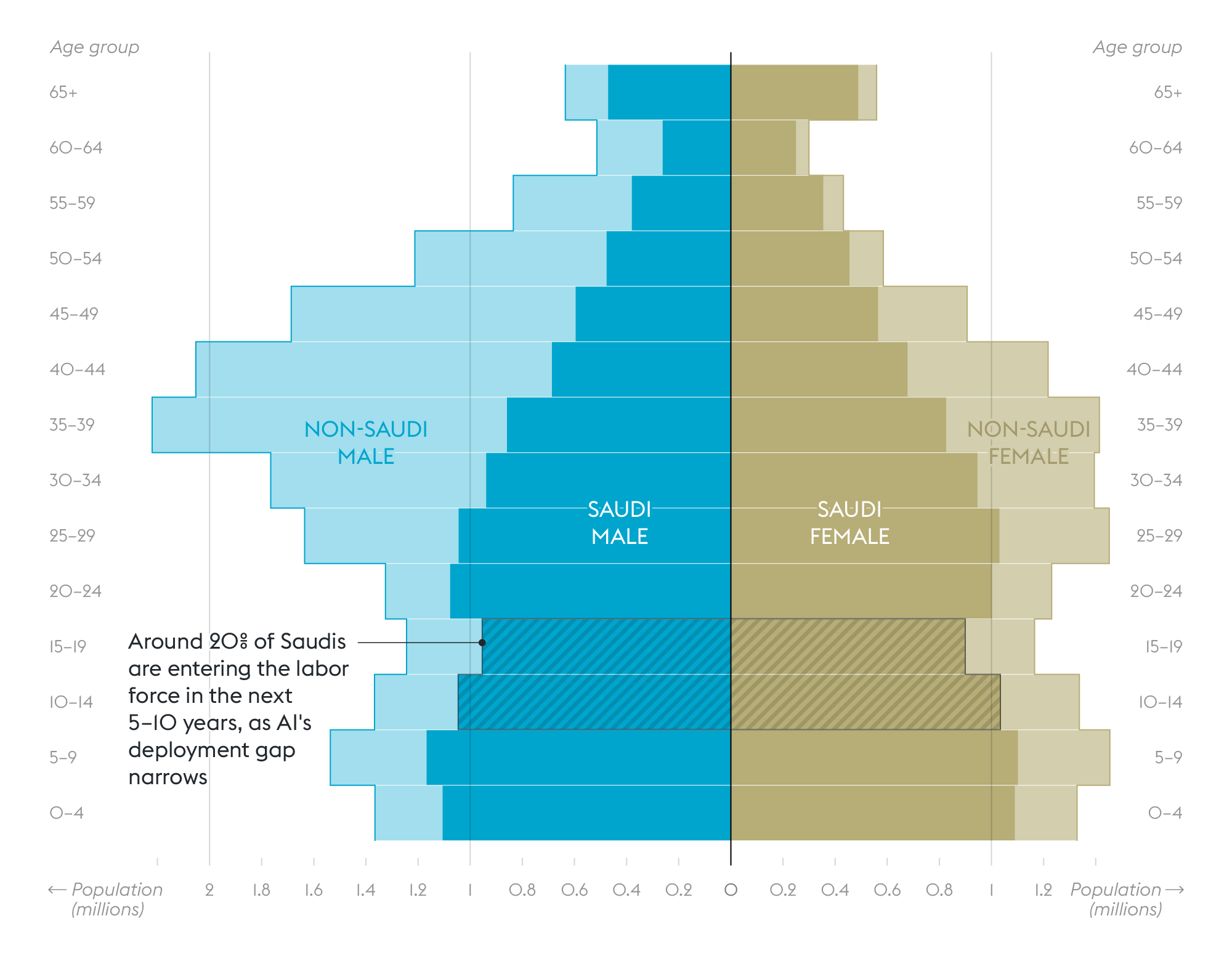
Aside from job occupations, the youth represent another cluster at the frontline, with preliminary evidence hinting a decline in employment rates among entry-level candidates in exposed occupations since 2022.[14] In Saudi, despite the demographic structure historically being on the younger side (Figure 5), there is an observed 50% decline in birth rates between 2000 and 2023.[15] Still, according to 2021 official figures, around one-fifth of Saudi nationals are between the ages of 15-24, and 28% between 10-24. This is the generation that is entering the labor market or will enter the labor market over the next decade, as AI’s deployment gap narrows. The implication is a compressed window: the current youth bulge will face peak AI exposure upon labor market entry, while the subsequent cohort will inherit an economy whose structure is mostly reshaped.
Figure 5: Saudi demographic structure in 2021, by age and nationality
Source: GASTAT.
Private sector sentiment
Boardroom conversations in Saudi Arabia can offer a precursor for incoming change in labor market demand.[16] Generally, 58% of CEOs view generative AI as an opportunity, with optimism rising to 65% among large firms. Meanwhile the remaining are cautions and see it as a risk due to accuracy concerns and difficulty measuring return-on-investment.
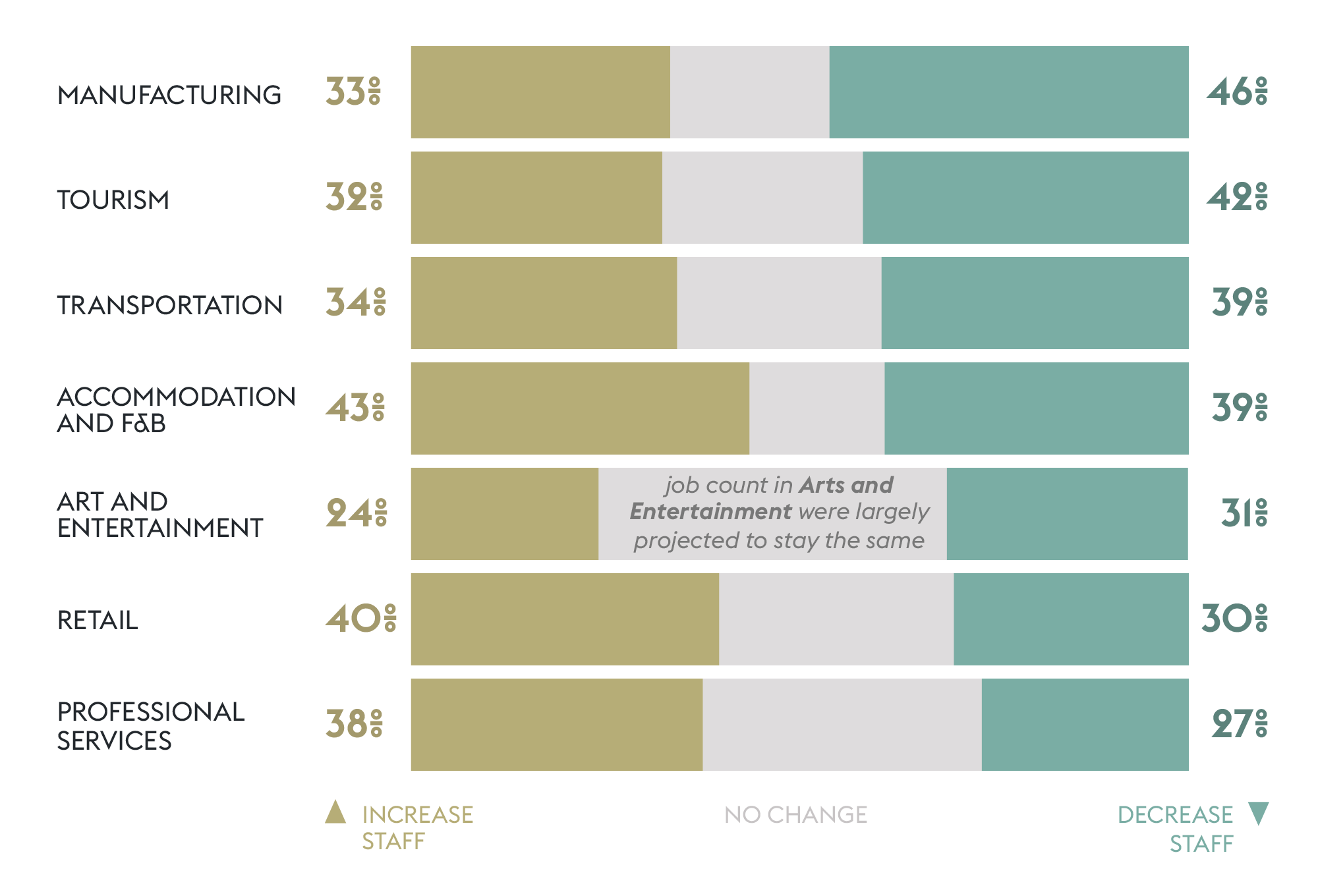
On workforce impact, views were split into one-thirds between increase in staff, decrease, and no change. Professional services firms, the sector most analogous to Anthropic’s high-exposure occupations, were the most likely to anticipate declining headcount (Figure 6), while job count in Arts and Entertainment were largely projected to stay the same according to CEOs. Overall, the sentiment of the 300 CEOs in the Kingdom seems consistent with empirical evidence: The job functions identified as most vulnerable to automation were administration, content generation, customer service, and legal support.
Figure 6: What Saudi CEOs think AI will do to their workforce
Source: Strategic Gears. CEO Outlook 2025.
Looking Ahead: Bracing for the diversification–automation paradox
The convergence of these dynamics creates what can be described as a diversification–automation paradox. Aside from tourism, Vision 2030 posits a deliberate diversification toward sectors, that now a decade after the program’s inception, are under high AI exposure: financial services, retail and sales services, and digital government. With Saudi committing to $100 billion in AI and compute investments, the paramountcy is therefore needed to find the pace at which the gap between capability and deployment is closing, and whether education outcomes and labor market institutions are calibrated to supply and absorb the adjustment. To this end, the below can serve as directional coordinates for future research that can inform the Kingdom’s educational and labor market development trajectories:
1. Use the adoption gap as a window: The divergence between AI capability and deployment constitutes a finite grace period. Future research should quantify the rate at which this gap is closing across priority Vision 2030 sectors (financial services, digital government, professional services) to inform the sequencing of regulatory frameworks, workforce reskilling programs, and statistical monitoring infrastructure before the window narrows.
2. Monitoring entry-level hiring: Standard unemployment statistics are not ideally equipped to detect the quiet decrease in entry-level positions. Longitudinal research tracking job-start rates by age cohort and occupational AI exposure can enable policy and decision-makers to identify displacement signals before they manifest in labor market indicators, and to calibrate interventions toward the most affected cohorts.
3. Identifying AI-complementary skill sets: The evidence suggests that AI is more likely to recombine task portfolios within occupations rather than eliminate them entirely. Research mapping the task composition of high-exposure occupations in Saudi Arabia, distinguishing automatable tasks from AI-complementary activities, would provide an empirical basis for curricula reform in higher education and technical/vocational institutions.
---
[1] Saudi Press Agency. March 2026.
[2] World Economic Forum. November 2024. “Saudi Arabia plans $100bn investment in AI.”
[3] Acemoglu, D. and Restrepo, P. 2019. "Automation and New Tasks: How Technology Displaces and Reinstates Labor," Journal of Economic Perspectives.
[4] Autor, D. 2022. "The Labor Market Impacts of Technological Change: From Unbridled Enthusiasm to Qualified Optimism to Vast Uncertainty," NBER Working Paper
[5] Anthropic. March 2026. “Labor market impacts of AI: A new measure and early evidence.”
[6] Ibid.
[7] GASTAT, Saudi Arabia.; Labor Market Observatory, United Arab Emirates.
[8] GCC Stat.; International Labor Organization. 2024. Modelled Estimates.
[9] Strategic Gears. July 2025. “Navigating Artificial Intelligence and Economic Uncertainty.”
[10] Based on data availability.
[11] GCC Stat.; UAE Labor Market Observatory.; International Labor Organization. 2024. Modelled Estimates.
[12] GASTAT, Q3-2025.
[13] Strategic Gears. August 2025. “From Vision to Scale: Saudi exports at the center of economic diversification.”; Arab News. December 2025.
[14] Brynjolfsson, E. et al. 2026. “Canaries in the coal mine? Six facts about the recent employment effects of artificial intelligence.”
[15] Estimates range – see Strategic Gears, October 2022.; World Bank, 2023. Arab News, 2025.
[16] Strategic Gears. July 2025. “KSA CEO Outlook: Navigating Artificial Intelligence and Economic Uncertainty.”