

What Makes Africa the Next Frontier for AI Infrastructure?
Six readings of Africa’s AI infrastructure
Africa holds some of the world's largest untapped clean-power resources at a time when power has become the main constraint on AI infrastructure. Rapid growth in AI, the concentration of data centers in a few hubs, and the strain this places on their grids are changing where new data-center capacity can be built. This article follows that shift in five steps: the demand AI creates, the part of that demand that can be located away from users, the bottleneck in the established hubs, Africa's untapped power, and what it would take to turn that power into capacity. Together, they show a continent with the resource that new data-center capacity increasingly depends on, and point to the grids, rules, and finance that will decide whether it is built.
Demand nearly doubles
From 485 TWh in 2025 to 945 TWh by 2030, more than Japan uses today; two-thirds of the rise is from AI.
Introduction
Since the launch of ChatGPT in November 2022, the expansion of artificial intelligence (AI) has traveled down its supply chain in sequence, from the applications people use to the electricity that powers them.
Figure 1
The AI ripple across the five layers of the AI stack, from 2022
ChatGPT, an application built on a large language model, launched in November 2022. Line thickness shows the strength of the ripple.
Source: Strategic Gears analysis (2026).
As Figure 1 shows, the expansion has been strongest at the top of the stack. ChatGPT reached an estimated 100 million users within two months of launch, the number of new foundation models more than doubled in 2023, and chip sales reached a record in 2024.1, 2, 3 Lower in the stack, the effect is only beginning to register. Chips require data centers, and data centers require electricity: the International Energy Agency (IEA) projects that data-center power use will more than double by 2030, while new grid connections in Europe's main hubs already take years.4, 5 Infrastructure and electricity are becoming the binding constraints, and for anyone building AI capacity the central question is shifting from where customers are to where power is available. This article examines why that shift positions Africa, which holds most of the world's best solar resources but less than 1% of global data-center capacity, as the next frontier for AI infrastructure.4, 6
Part of AI's electricity demand can go where the power is
The world uses about 28,200 terawatt-hours (TWh) of electricity a year, and the International Energy Agency (IEA) expects about 33,600 TWh by 2030, a rise of about 5,400 TWh.7 Most of that growth has long-standing drivers. In emerging and developing economies, where demand is rising fastest, the IEA attributes it mainly to economic growth, industrialization, wider use of appliances, and the need for cooling.
Among the sources of new demand, data centers are the fastest-growing. The IEA expects their electricity use to grow by around 15% a year to 2030, more than four times faster than consumption from all other sectors.4 Their contribution to global demand remains modest: 485 TWh in 2025, rising to 945 TWh by 2030, 2.8% of global electricity and slightly more than Japan’s total consumption today (Figure 2).4, 8 Most of this growth comes from artificial intelligence. The IEA expects consumption by AI-focused data centers to roughly triple, from about 150 TWh in 2025 to around 465 TWh in 2030, which accounts for about two-thirds of the sector's growth (Figure 3).8
Figure 2
World electricity consumption and the data-center share, 2023–2030 (TWh)
World totals for 2023 and 2024 are derived from the 2025 level and reported growth rates. 2030 is the IEA Base Case.
Source: International Energy Agency (2025, 2026).
Figure 3
AI’s share of data-center electricity consumption, 2025 and 2030 (TWh)
The split is read from the IEA chart and rounded to 5 TWh. 2030 is the IEA Base Case.
Source: International Energy Agency (2026).
AI's electricity demand comes from two workloads with different location requirements: training, in which a model is developed by processing large volumes of data, and inference, in which the deployed model responds to users. At OpenAI, research and training took an estimated $5.0 billion of $6.8 billion in compute spending in 2024, against $1.8 billion for serving users (Figure 4).9
Figure 4
OpenAI’s compute spending by use, 2024 (estimated $6.8 billion)
Estimates based on OpenAI investor figures; partly projected.
Source: Epoch AI (2025), from figures reported by The Information and The New York Times.
Inference is shaped by proximity. Because it responds to users in real time, many inference workloads benefit from being located close to them, as video streaming and web hosting have been before. Data-localization rules reinforce this pattern by giving governments a reason to keep such workloads within national borders.
Training is governed by different constraints. Because no user waits on the result, it is less sensitive to latency, and the IEA notes that training and some forms of inference can therefore be sited where grid access and generation capacity are available, rather than near users.4
This makes part of AI's electricity demand geographically mobile. Training and delay-tolerant inference can be located in any country that offers reliable, low-cost power and timely grid connections.
Data-center capacity is growing fast in a few hubs, and their grids are becoming the bottleneck
This growth is not spread evenly. Data-center capacity is concentrated in a few regions and, within them, in a few clusters: North America, Asia Pacific, and Europe account for almost all data-center electricity use (Figure 5). In Ireland, data centers already use 22% of the country's metered electricity, and almost all of them are located in Dublin.10
Figure 5
Data-center electricity consumption by region in 2024, with global consumption in 2024 and 2030 (Base Case)
Source: International Energy Agency (2025).
New capacity is reinforcing this pattern. About 90% of the 112 gigawatts (GW) of capacity the IEA expects to be added worldwide by 2030 is in North America and Asia Pacific (Figure 6).
Figure 6
Data-center capacity added by region, 2023–2025 and expected 2025–2030 (GW)
For the three smallest regions, the first value is 2023–2025 and the second 2025–2030.
Source: International Energy Agency (2026) and Strategic Gears calculations (2026).
Grid infrastructure expands more slowly than the facilities it serves. A data center can be operational in two to three years, whereas new transmission lines take four to eight years to build in advanced economies.4 In the United States, large power transformers now take about three years to deliver, compared with less than a year before the pandemic.11
In the most concentrated hubs, this gap now limits new connections. Grid connection queues in Europe's main hubs average seven to ten years,5 and in Ireland the energy regulator now requires large new data centers to provide their own generation or storage before they can begin operating or ramp up to full load.12 Worldwide, the IEA estimates that around 20% of planned data-center projects could be at risk of delays unless grid risks are addressed.4
In essence, data-center capacity is growing fastest where grids are least able to absorb it, and its expansion is now paced by access to electricity that can be connected in time. The IEA identifies building data centers where grid and generation capacity are available as one way to reduce that risk, which turns the question to where such capacity exists.
Africa holds some of the world's largest untapped clean-power resources
Africa's renewable power resources are among the largest in the world, and almost all of them are untapped. At the end of 2025, the continent had 82 GW of renewable power capacity, 1.6% of the global total, even after a record 11.3 GW of additions that year.13
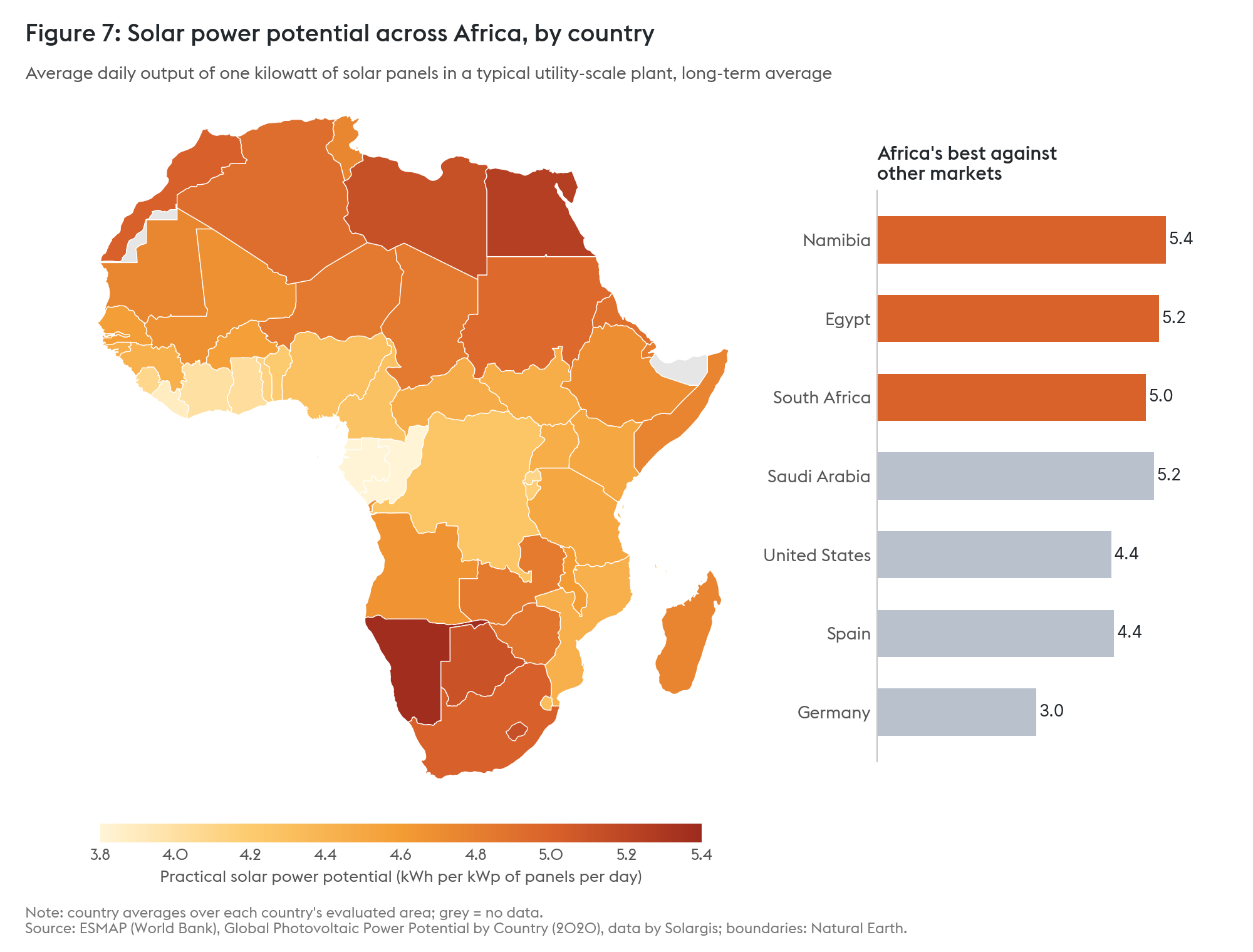
Solar is the largest of these resources. Africa holds 60% of the world's best solar resources but only 1% of the world's installed solar PV capacity (Figure 7).6 IRENA estimates the continent's technical potential for solar power at 7,900 GW, assuming only 1% of the land is used,14 nearly a hundred times Africa's entire renewable capacity today.
Hydropower and wind extend the same picture. Africa has developed only about 10% of its hydropower potential,15 and the International Finance Corporation estimates that the continent's onshore wind resource could meet its electricity demand 250 times over.16
These resources are already competitive. The IEA describes solar power as already the cheapest source of electricity in many parts of Africa and projects that, under its Sustainable Africa Scenario, it outcompetes all other sources across the continent by 2030. Onshore wind in Africa generated at around 5 US cents per kilowatt-hour in 2024, similar to Europe, even though capital is far more expensive in Africa: 12% against 3.8% in Europe in IRENA's estimates.17
Resource alone, however, has not been enough to draw investment. Africa is home to 20% of the world's population but attracts less than 2% of global spending on clean energy.18 What separates the continent's resource from built capacity is the set of conditions that allow projects to be financed, connected, and operated over decades: the cost of capital, the reach and reliability of grids, and the rules that govern long-term investment. These conditions will decide whether Africa's resource becomes capacity for data centers.
What it would take to turn Africa's power into data-center capacity
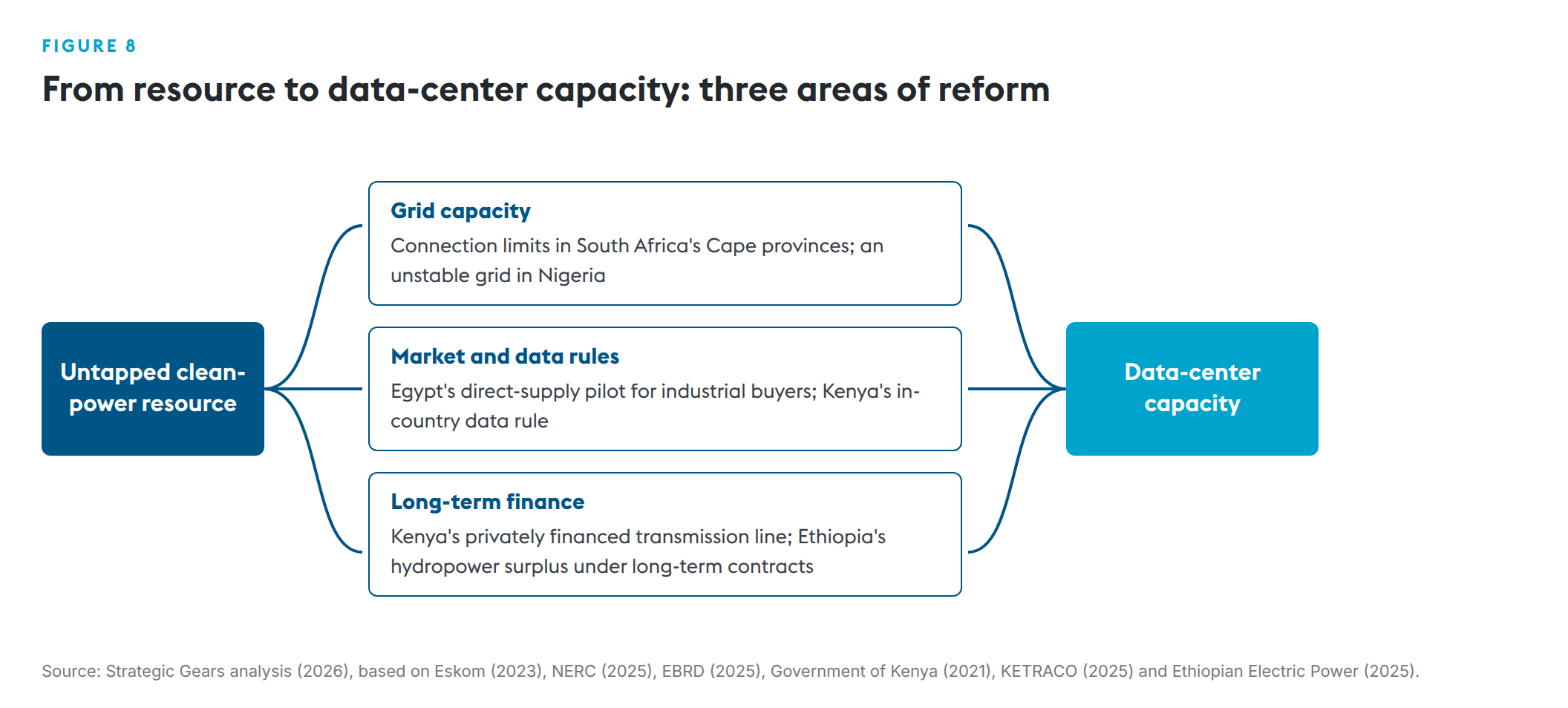
Closing the gap between resource and capacity is a national task. Capital for utility-scale clean power in Africa costs at least two to three times as much as in developed economies and China, and under the IEA's Sustainable Africa Scenario, grid investment would need to rise from around $10 billion a year to nearly $50 billion by 2030.18 The experience of Africa's main markets points to three areas of reform (Figure 8).
Grid capacity
Generation is only as useful as the grid that carries it. South Africa illustrates the constraint: Eskom's 2023 assessment found connection capacity depleted in the Northern, Western and Eastern Cape, where the country's strongest wind and solar resources lie, and the transmission needed to release it is not due before 2027.19 Reliability is the parallel constraint. In Nigeria, grid-connected plants had 5,430 MW of capacity available on average in the third quarter of 2025, against 13,625 MW installed, and the grid collapsed entirely in September of that year.20
Market and data rules
Data centers require the ability to contract power directly and clarity on where data may be hosted. Egypt has begun to relax its single-buyer model: under a pilot approved in 2025, four 100 MW renewable projects were cleared to supply industrial buyers directly over the national grid.21 Kenya, for its part, requires certain categories of state data to be processed or stored domestically,22 establishing a base of local demand that data-center investors can plan around.
Long-term finance
Long-lived infrastructure depends on finance structured to match it. Kenya's grid already runs largely on renewables: geothermal, hydro, wind, and solar supplied 79% of its interconnected-system electricity in the year to June 2026 (Figure 9).23 To carry more of that power to load, Kenya is building a $311 million transmission line from its North Rift geothermal fields without public funds, with costs recovered through an availability-based tariff over 30 years.24 Ethiopia, whose Grand Ethiopian Renaissance Dam reached 5,150 MW at its inauguration in 2025, holds a surplus that long-term contracts with creditworthy buyers, data centers among them, could absorb.25
Figure 9
Kenya’s electricity mix, year to June 2026 (% of interconnected-system electricity)
Other sources are calculated as the remainder.
Source: Energy and Petroleum Regulatory Authority (2026).
Looking ahead
Across these markets, generation can be built faster than it can be connected and contracted. Closing that gap is what turns Africa's resource into capacity that data centers can use.
The first steps are under way. The IFC is providing up to $100 million for ten edge data centers totalling 13.5 MW in seven countries, using blended finance without which, its disclosure states, it would not be able to invest.26 At the continental level, the AfCFTA Protocol on Digital Trade, adopted in 2024, makes cross-border data flows the default and bars member states from requiring computing facilities to be located in their territory as a condition of digital trade, subject to public-policy exceptions.27
Each group of stakeholders has a part to play:
- Governments: complete the transmission corridors that connect the best resources, open grids to private supply, and set clear terms for data hosting and long-term power contracts.
- Developers and investors: pair data-center sites with dedicated generation, starting in markets where grid access and power-purchase terms are already clear.
- Development finance institutions: use guarantees and concessional capital to lower the cost of capital; the IEA estimates that around $28 billion a year of concessional finance is needed by 2030 to mobilize $90 billion of private investment in African energy.18
Africa can become the next frontier for AI infrastructure because it can still build and connect new power. The markets that first offer connected sites under long-term power contracts will draw that investment.
References
- 1
- 2
- 3
- 4
- 5
- 6
- 7
- 8
- 9
- 10
- 11
- 12
- 13
- 14
- 15
- 16
- 17
- 18
- 19
- 20
- 21
- 22
- 23
- 24
- 25
- 26
- 27