

 Digital Transformation
Beyond the Hype: How to get the GenAI foundations right
September 10, 2025
The takeaway: The notion that GenAI will make organizations perform better and faster needs to be nuanced: only when it is built on the right foundations. Those that repeat mistakes of previous technology adoption cycles may see pilots that impress in demos but fail in practice. The challenge for leaders is to resist the allure of short-term visibility and instead invest in getting the foundations right: align compute capacity with enterprise needs, treat data as an enduring asset, and institutionalize interoperable analytics across functions. With these elements in place, GenAI shifts from hype to sustained value creation.
 Business Strategy
Preparing to execute: Four pillars to succeed in strategy implementation
July 2, 2025
The takeaway: Successfully implementing a strategy is an age-old challenge for organizations. Much focus is placed on design, coordination, and resource allocation as avenues where derailment can happen. However, one of the most impactful issues that does not receive a fair share of attention is poor preparation and foresight over how to turn a strategy into practice. This article advances four pillars that can help leaders better materialize their organization’s aspirations: defining an operating model, cascading the strategy into key objectives, managing performance, and regularly validating progress.
 Digital Transformation
Government of the Future: Saudi Arabia’s ongoing digital transformation
May 19, 2025
The takeaway: Digital transformation holds many promises for the public sector: improved government efficiency, stronger citizen engagement, and better policy outcomes. In pursuit of these, Saudi Arabia has so far digitized over 97% of its government services in nearly two decades. This transformation, which has involved distinct phases of digitization and digitalization, demands an equal push in data governance and cybersecurity—areas that often lag in many emerging economies. The future for this momentum, however, lies in recognizing that digital transformation is a process rather than an endpoint, and thus merits a curiosity-centric approach that ensures digital systems are robust and sustainable as technologies around us continue to evolve.
 Technology & AI
AI at an Inflection Point in Saudi Arabia: Insights from Our Technology Leaders
May 15, 2025
With the announcement of the HUMAIN–NVIDIA partnership, Saudi Arabia is taking a decisive step toward turning its AI ambition into national capability as part of a broader $10 billion investment plan. As artificial intelligence becomes a cornerstone of economic competitiveness worldwide, the Kingdom is positioning itself as more than just an adopter—it is making strikes towards becoming a builder of sovereign AI infrastructure, enabler of local innovation, and contributor to the global AI economy.
 Autonomous Vehicles
Driving Tomorrow: The bumpy road to adopting autonomous vehicles
May 5, 2025
The takeaway: Self-driving cars are poised to transform urban mobility, with the potential to reduce congestion, lower emissions, widen accessibility, and make roads generally safer. While often hailed as the transportation industry’s most anticipated innovation, discussions surrounding autonomous vehicles (AVs) tend to focus on their economic return, software capabilities, and manufacturing scalability, with less attention given to integration to daily life. Yet despite rapid technological progress, adoption rates remain slower than initial expectations. This blog clarifies the complexity of integrating AVs, unpacking three underlying reasons (regulatory fragmentation, infrastructure gaps, and lagging public trust), and recommends targeted policy frameworks and stakeholder collaboration as critical levers to meaningful AV deployment.
 Economic Analysis
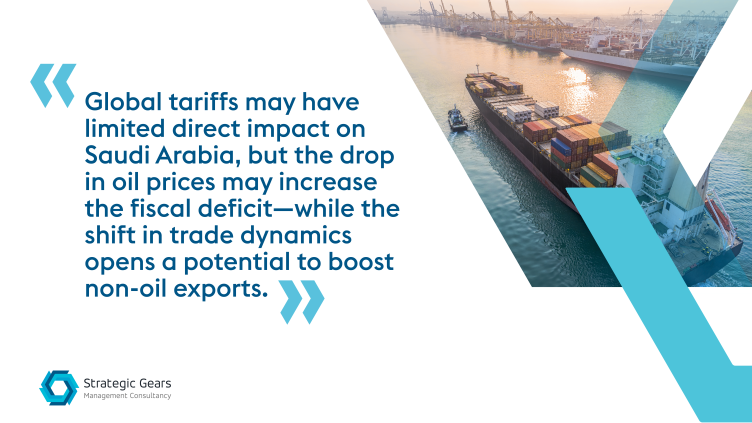
What do the latest global tariffs mean for Saudi Arabia?
April 23, 2025
The takeaway: While the direct impact of the US-induced global tariffs for Saudi Arabia is expected to be minimal, the broader ripple effects—particularly from falling oil prices—could pose fiscal pressures. With the likelihood of a growing budget deficit, the Kingdom may need to review its fiscal forecasts for the short-to-medium term. At the same time, shifting global trade dynamics offer a strategic opening: Saudi Arabia can step in as a US supplier in multiple sectors and attract new manufacturers seeking low-tariff zones. In a nutshell: There will be a limited direct impact: The 10% US tariff on Saudi exports is unlikely to significantly disrupt trade volumes, as oil—Saudi’s main export to the US—remains exempt. The real risk is oil price shock: The Kingdom faces fiscal pressure from declining oil prices, which could more than double its budget deficit if crude stays around $60/barrel. Currency shifts add another layer of risk: The possibility of a weakening US dollar—combined with low oil prices—may decrease the real value of oil revenues and increase the cost of imports, adding pressure to the Kingdom’s inflation level. Still, there is a strategic upside for Saudi: As the US-China trade tensions leave a market gap, Saudi Arabia has an opportunity to capture export share in petrochemicals and attract global manufacturers seeking low-tariff trade zones.

Articles
The latest insights, strategies, and thought leadership from our consulting experts.
Featured Topics
Industries